Featured Faculty
James Farley/Booz, Allen & Hamilton Research Professor; Professor of Managerial Economics & Decision Sciences; Director of the Ford Center
Michael Meier
More and more of us are turning to AI chatbots for information and advice, including about politics. We ask, for example, about political candidates and their positions, about economic conditions, and more broadly about which policies are best.
While AI is by no means perfect, it has a lot of potential as a go-to source for political information. It draws almost instantly from an enormous pool of information, it allows people to ask questions without fear of being stigmatized, and it can explain its answers in a way that the individual user understands, says Georgy Egorov, a professor of managerial economics and decision sciences at the Kellogg School. “We haven’t seen anything like that before.”
However, AI’s ability to tailor answers to individuals could potentially be problematic. AI chatbots like Gemini and ChatGPT have a well-documented tendency to be too agreeable—and at times sycophantic—even to the point of twisting the truth. And indeed, there is a common perception that such pandering could trigger an echo-chamber effect that reinforces existing views and stokes further division.
Research by Egorov and Konstantin Sonin of the University of Chicago suggests that this echo-chamber effect is actually not the biggest risk of using AI for political information. They developed a theoretical model of AI providing political advice that is personalized to the individual asking a question. And they found that when what people believe is consistent with what they would prefer to believe, AI’s incentive to pander is relatively limited and its advice more informative.
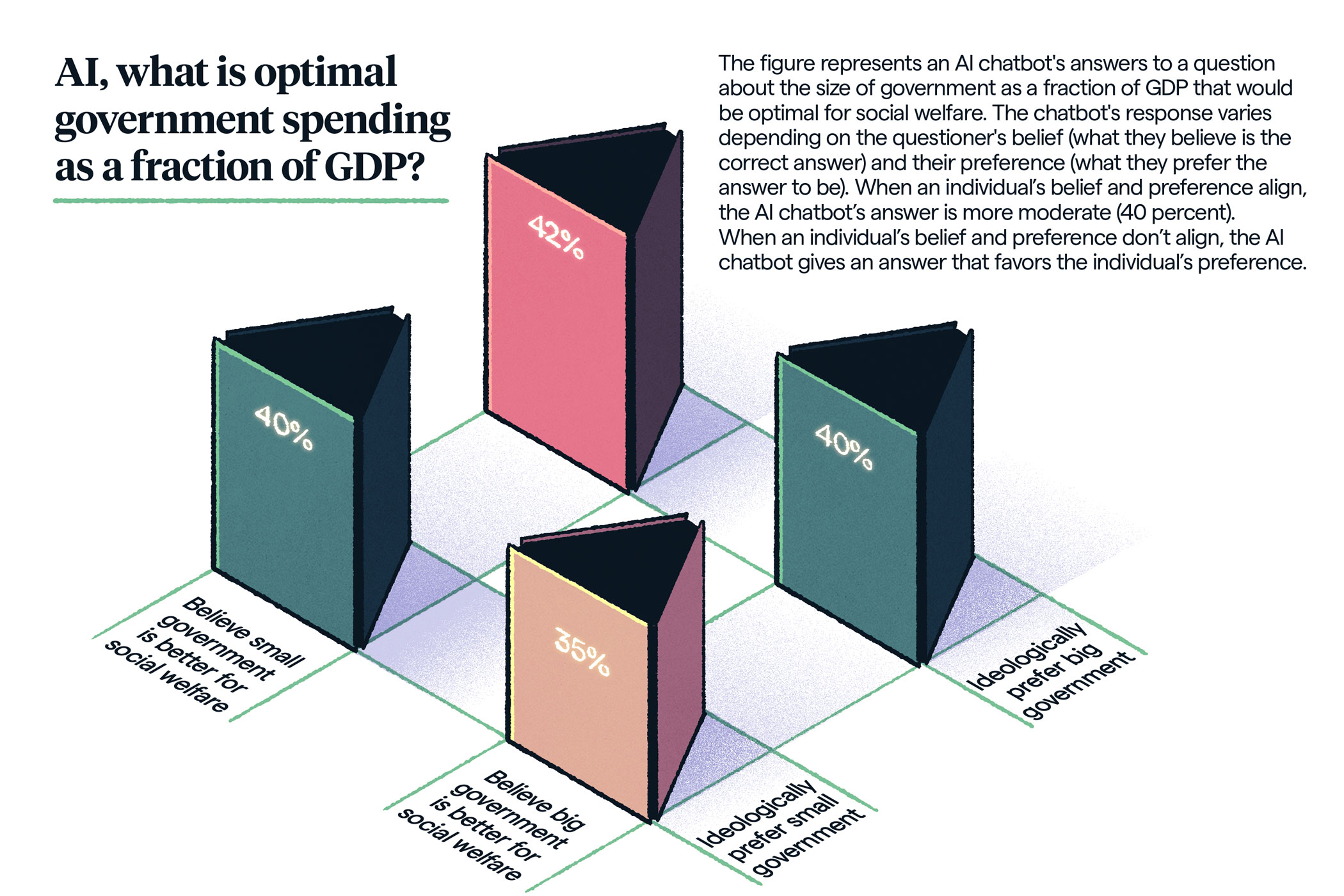
“The real problem is when you have people who are generally torn between what they think is right and what they prefer to be right, especially when they are uncertain about what the truth is,” Egorov says. “These are the people probably most likely to reach out to AI. And these are the situations where you indeed may have AI communicating extreme messages.”
In Egorov and Sonin’s theoretical model, individuals ask an AI chatbot questions about political issues. The model assumes that the people who talk with this chatbot have a sincere desire to learn about something they have little information about, and the little information they do have may or may not align with their personal preferences.
Take, for example, the issue of gun control. Imagine someone who starts with the belief that widespread gun ownership increases crime and asks the AI chatbot for evidence or studies about it. If this person is also ideologically opposed to guns, they would be glad if the chatbot confirmed what they already believed. In this case, the person’s prior belief and preference are aligned.
Conversely, imagine a second person with the same prior belief as the first person but who is a strong supporter of the Second Amendment, because they place a high value on gun ownership as an important safeguard against a tyrannical government. In this case, the person’s belief and preference clash. This individual would be thrilled to learn from the chatbot that gun ownership does not meaningfully increase crime, and could even decrease crime, because then their support of the Second Amendment would not come at the expense of public safety.
“AI anticipates the sophisticated individual will subtract its personalization bias, and it doubles down.”
—
Georgy Egorov
The model also assumes that the AI chatbot is familiar with the person it is talking to, including their beliefs and preferences. This is already common for chatbots today, as people talk to the same chatbots repeatedly and reveal a lot about themselves. It’s not a stretch to expect AI to become even better at this in the near future, Egorov says. The AI chatbot also faces a tension of its own. On the one hand, it has factual information and is designed to be truthful and give accurate advice. On the other hand, it also wants to please the people it talks to by catering to their preferences.
“AI knows something about me, and every time we interact, it learns more,” Egorov says. “And if it wants to make me happier—which is well-documented they do—it has an incentive to give me information that would move my beliefs closer to my preferences.”
Much of the concern about politics today is centered on its polarization. People often point the finger at echo chambers, which reinforce what people already believe and push different groups apart. AI seems poised to make this problem even worse.
“When prior beliefs and preferences coincide, you would think that this is exactly the situation where people would favor hearing repetitions of their beliefs and find themselves in their own echo chamber,” Egorov says. “You would think that this is exactly what makes AI problematic.”
And yet the model points to a different conclusion.
When interacting with people who are already content with their beliefs and preferences, there is less for AI to gain by distorting the message. “Because these people are already kind of happy, AI tries, on the margin, to pull them toward the truth,” Egorov says. “If all people were like that, then, over time, AI would bring them together.”
The real problem arises when people’s beliefs and preferences are not aligned. The researchers’ model shows that, in this case, AI caters to people’s preferences rather than reinforcing what they already believe. It may even exaggerate and give answers that are considerably more extreme than what the person would like to hear. That, in turn, can lead to further polarization.
“AI knows it has to offset their prior beliefs, so it overshoots considerably,” Egorov says, “and its message becomes more distorted.”
The model’s predictions can be translated into practical advice for people seeking information from AI.
Some people are aware that chatbots tend to pander. These “sophisticated” users understand that an answer may be personalized and try to correct for bias. But if AI thinks it’s dealing with a sophisticated user who will filter its pandering, it has an incentive to distort the message even further. It would thus offer a more-extreme and less-informative view of the world.
“AI anticipates the sophisticated individual will subtract its personalization bias, and it doubles down,” Egorov says.
Another prediction concerns how strongly people hold onto their prior beliefs. AI is more likely to distort its answers for people who are uncertain and therefore especially receptive to its responses. If someone appears knowledgeable or simply confident in their prior knowledge, AI will find it difficult to change their mind and give a more-truthful answer.
“If you are genuinely open-minded, AI might say to itself, ‘Aha, this is exactly the right person for manipulation,’” Egorov says. “Conversely, if you’re dogmatic, then AI is going to tell you the truth; it gives up on trying to change your belief.”
Taken together, these results suggest a paradoxical strategy for people who want informed and unbiased answers from AI: show AI that you already have strong prior beliefs, and be aware of its pandering—but do not advertise that you are aware of it. In other words, give AI less reason to try to change your mind and less reason to compensate for your attempts to correct its bias.
“So basically, you want to appear naïve and dogmatic to AI,” Egorov says, “even if you are sophisticated and open-minded—that’s probably the mantra.”
Abraham Kim is the senior research editor of Kellogg Insight.
Egorov, Georgy, and Konstantin Sonin. 2026. “Artificial Intelligence and Political Advice.” Working paper.