Featured Faculty
Leadership Artificial Intelligence Oct 22, 2026
AI Agents Are Here. Are Leaders Ready?
“How do we make sure we are effectively using AI … and not lose our soul in the process?”
Yevgenia Nayberg
Summary AI agents that can perform complex tasks have the potential to dramatically transform fields such as medicine and law that were previously resistant to automation. Kellogg’s Harry Kraemer and his collaborators argue that leaders must educate themselves now about this technology and the questions it raises. Leaders should look beyond using AI agents for merely cutting costs and consider new opportunities, question whether today’s agents are reliable enough for sensitive tasks, concentrate even harder on training future leaders and retaining employees, and assess what their human values still bring to increasingly automated organizations.
Are we entering the age of the agents?
The latest wave of AI excitement is focused on agents—computational assistants that can automate complex tasks with little or no human supervision. Already, today’s agents can help write code or respond to emails, find the best deal on flights and hotels, or conduct deep research on virtually any topic.
But the impact of this “cognitive automation” may run much deeper, transforming businesses and entire fields as more human work shifts to AI. That means leaders are starting to ponder enormous questions about how AI agents may disrupt business and society, says Harry Kraemer, a clinical professor of management and organizations at Kellogg.
“They’re asking, ‘How do we make sure we are effectively using AI to enhance our lives and not lose our soul in the process?,’” says Kraemer, the former CEO of Baxter. “How do we control AI and not have AI control us?”
Kraemer assembled a multidisciplinary team, including physician and healthcare administrator Mitch Kentor, organizational psychiatrist Daven Morrison, and technologist and entrepreneur Matt Pipke, to grapple with these questions. The quartet is working on a series of articles about the business, cultural, and psychological implications of agentic AI, from the worst-case scenario of mass unemployment to optimistic visions of exploding productivity and abundance.
The stakes are incredibly high, they argue in their first installment. The agentic-AI transformation could equal or surpass that of the Industrial Revolution—and it’s unfolding much faster than the invention and spread of the steam engine and the electric motor. So now is the time for leaders to educate themselves.
“The decisions that business leaders need to make today about how we use and implement these technologies are going to have a major impact, not just for that corporation, but really for how society views and is impacted by these technologies,” says Kentor, a Kellogg MBA alumnus. “So, I think there’s an incredible need for business leaders to understand this technology and stay up to date as it continues to change.”
For now, here are four issues leaders should be thinking about as their organization or team starts using agents.
Should you cut costs or do more?
The growing ability of AI agents to perform tasks that used to be the exclusive domain of humans has inspired a familiar anxiety: will this mechanical competition steal people’s jobs?
But history suggests that these fears are overblown. Technological advances from the cotton mill to the personal computer have typically created more jobs, shifting work instead of eliminating it.
“Every time we have a new technology, there is this view that it is going to significantly increase unemployment,” Kraemer says. “Over time, the reality is we end up creating jobs and occupations that never existed before.”
As such, smart leaders should look beyond where AI enables cost cutting. Instead, they should focus on how automating routine tasks can free people up to be more productive than ever.
“I think leaders will begin to see their organizations in a new light. It’s almost like being able to suddenly see in ultraviolet,” Pipke says. “It becomes more like, what are we about? What do we want to achieve? What can we do? Should I just cut jobs andmake my widget for cheaper, or should I try making better widgets?”
Can you trust your agents?
Automation has traditionally targeted manual and repetitive tasks in manufacturing and clerical domains. But the ability of AI agents to perform cognitive labor opens new possibilities for automation in previously resistant fields such as law and medicine.
Healthcare, in particular, is full of small but important tasks such as scheduling appointments, following up with patients after their visits, and issuing or renewing prescriptions.
“If you’re in a large health system, you might do some of these tasks millions of times per year for a large patient population,” Kentor says. “To have something that can accurately and quickly do or assist with that work is incredibly powerful.”
But the risk of getting things wrong in these systems is also much higher than in other industries. Leaders need to understand the current capabilities of agentic AI and determine whether they are reliable enough to handle what is often high-stakes work.
“I do not believe that AI is going to ever impact values. I think that values are a process that requires trust, heart, and care.”
—
Harry Kraemer
Kentor also recommends a “human in –the lead” approach, where domain experts spend their time supervising the work of agents instead of doing the work themselves.
“That’s where I think we’re going to have this tension,” Kentor says. “There’s huge potential from this enormously powerful technology. But at the same time, we are very much still at a point where we need to make sure it is doing the thing we want it to do, that we are verifying the outputs that we’re getting from it.”
How do you train and retain future leaders?
Delegating the “busy work” of professions like law, medicine, and finance to AI agents may sound like a win for efficiency. But the short-term gains may also come with a long-term cost, as early-career employees lose the hands-on experience that builds the foundation for their career.
“A junior accountant goes through a lot of pretty simple, rote stuff, but that helps you understand the balance sheet and the accounts. It helps you get a feel from the ground up,” Kraemer says. “By eliminating some of these junior and first-level managerial roles, how will you develop into a senior manager? When I talk to CEOs right now, they’re really trying to figure that out.”
Kraemer and his coauthors warn that the organizational pyramid could be transformed into an organizational diamond, where increased use of AI for entry-level work erodes the necessity to retain the layer of young talent on which the company’s future depends. New training pipelines will need to be developed that give junior employees relevant job experience.
“You have to consider the cost to the organization of not developing senior leaders and experts for the future,” Kentor says. “Otherwise, there’s nobody that really is ready to step into a senior role and lead.”
Higher levels in the organization may also be newly vulnerable to attrition in this new era. Companies will need to step up their employee retention efforts, because AI agents will make it easier than ever for talented workers to leave and start their own businesses—a “wave of micro-firms,” Pipke predicts. The best counterweight to this technological threat may be a much less cutting-edge concept: company culture.
“I think it’s going to increase the need for strong senior-, middle-, and lower-management interconnections and interest in real personal human connection,” says Morrison.
Where do your values fit in?
In all the excitement about AI and agents, it’s important that leaders not lose sight of their most-valuable offline traits.
“I do not believe that AI is going to ever impact values,” Kraemer says. “I think that values are a process that requires trust, heart, and care.”
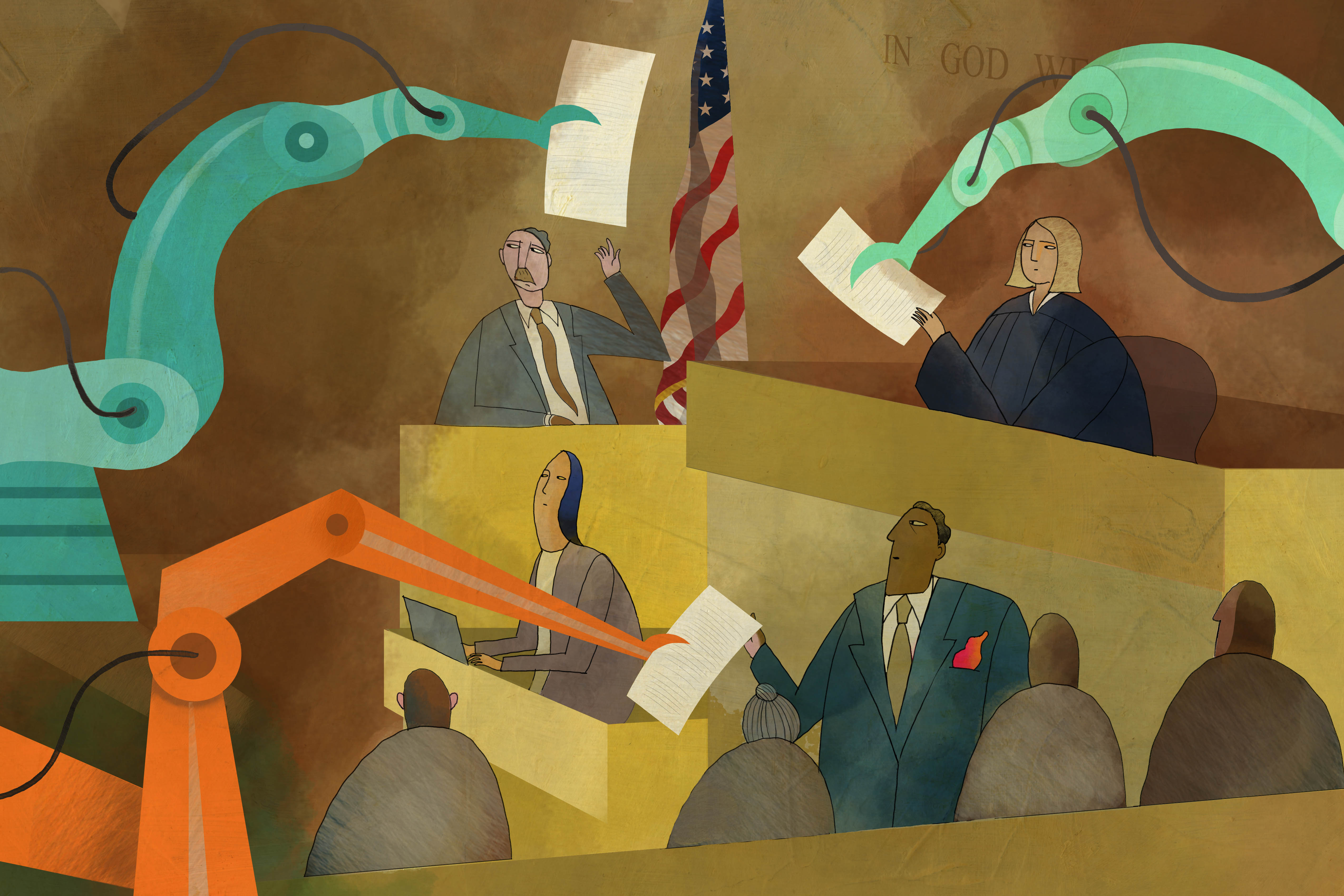
The promise of AI agents for cognitive automation needs to be balanced with the caution that these tasks are also the ones where human judgement is often necessary. It’s one thing to put a robotic arm on an assembly line but something else entirely to put a computer program in charge of approving or rejecting insurance claims.
As they grappled with this dilemma, the team found themselves returning to qualities that can’t easily be quantified, optimized, or automated. In those new human-in-the-lead systems, feelings may become important signals.
“Emotions are not something to get rid of. They’re actually data to help you solve problems,” Morrison says. “Emotions keep you in touch with reality.”
Knowing your true self and values as a leader will be more critical than ever, the authors argue. Fortunately, the time-saving productivity boosts from AI agents may also free up more time for introspection and self-improvement.
“What if this technology could give us time to actually slow down and prioritize what really matters?” Kraemer asks. “To the extent that AI gives me more time to think about what’s really important, to develop people, to spend time with people, to get people to trust me, I’m going to be a much better leader.”
About the Writer
Rob Mitchum is editor in chief of Kellogg Insight.
Insight in your inbox
Receive our newsletters to keep up with the latest research and ideas from faculty at the Kellogg School of Management.
This website uses cookies and similar technologies to analyze and optimize site usage. By continuing to use our websites, you consent to this. For more information, please read our Privacy Statement.