Featured Faculty
Human Behavior Marketing Social Impact Dec 1, 2025
When It Comes to Giving, People Value Time over Money
Monetary donations are generally more helpful for charities. So why do people prefer to donate their time instead?
Lisa Röper
Summary In a series of studies, Kellogg's Rima Touré-Tillery and Kellogg alum Samantha Kassirer examine people’s willingness to donate either their time or their money to a charitable cause. They find that people are generally more willing to give their time, because doing so makes them feel like they are making a more-personal contribution. This, in turn, makes them feel like donating time is more meaningful and, subsequently, more effective than donating money—even though past research has shown that monetary donations are generally more effective.
Think about your favorite charity. Would you rather volunteer a Saturday afternoon to help it out or write it a check for $100? Whichever you prefer, you—like many others—would probably want your donation to have a meaningful impact.
Indeed, prior research has shown that people are more likely to make a donation the bigger the impact they believe it will have. For example, people are willing to donate more money to charities the more cost-effective they believe they are.
So, when people are deciding between giving time or money to their chosen cause, their decision may ultimately come down to which of the two they believe is going to be more impactful or effective.
In a series of studies, Kellogg associate professor of marketing Rima Touré-Tillery and incoming assistant professor of marketing at Michigan Ross and Kellogg alumna Samantha Kassirer examine people’s willingness to donate either their time or their money.
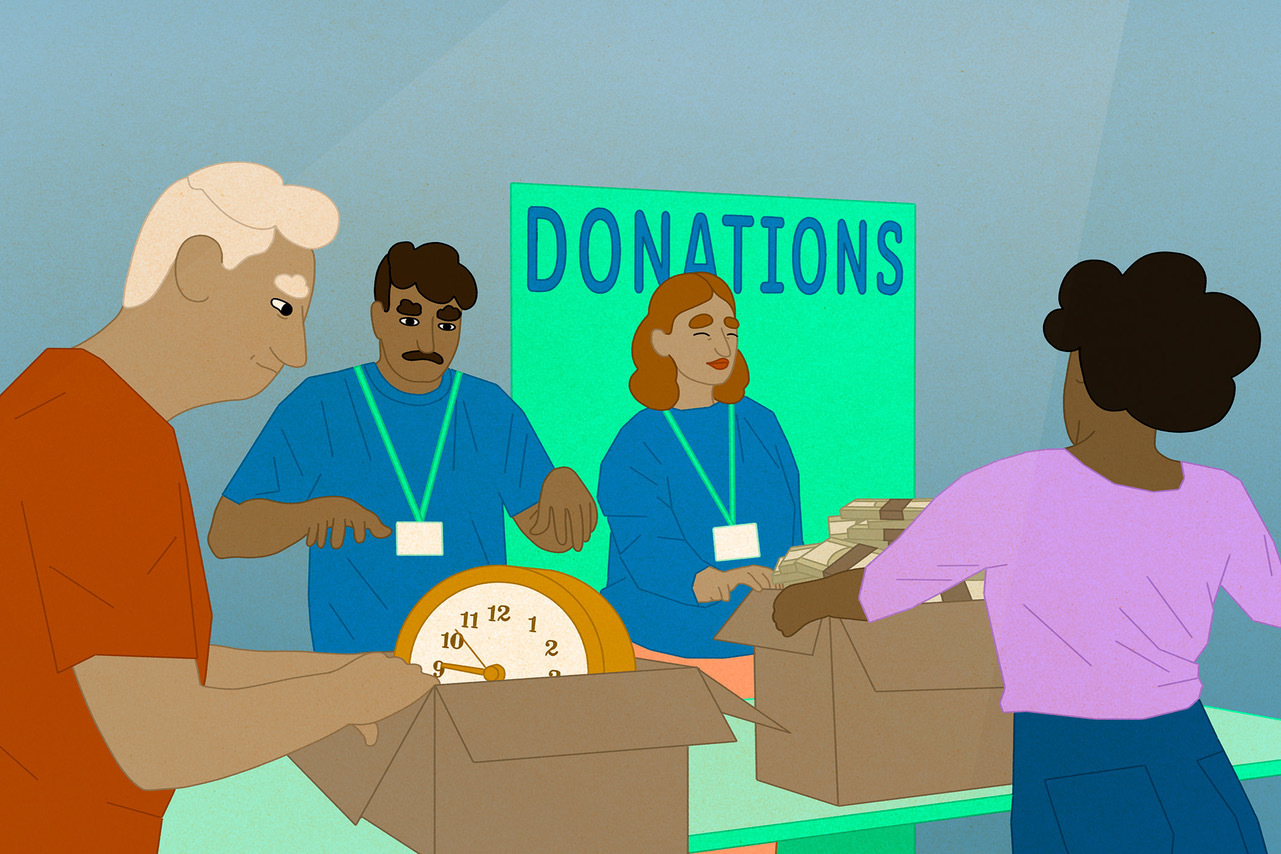
They find that people are generally more willing to give their time, because doing so makes them feel like they are making a more-personal contribution (what the authors refer to as greater “self–gift overlap”). This, in turn, makes them feel like donating time is more meaningful and, subsequently, more effective than donating money.
“People see less of themselves in their money and more of themselves in their time,” Kassirer says. “That’s why people expect their time to be more effective than their money.”
“The result,” Toure-Tillery adds, “is that people will choose to donate time instead of money, even if it is objectively less effective in the end.”
Time or money?
Even before she began looking into this study on charitable giving, Kassirer was no stranger to the topic.
“I have volunteered my whole life and come from a family that praised volunteerism,” she says. “So I was interested in this puzzle of figuring out the most-effective way to give.”
When Touré-Tillery and Kassirer began exploring the topic, they found that most people who donate seem to believe that it is more effective to give their time than their money, even though past research has shown the opposite—that money is usually more effective. In fact, when the researchers did their own calculations comparing the value of giving time versus money, they found that, on average, donating an hour of one’s salary had a significantly bigger impact than volunteering one hour of time. This disconnect between what people think is valuable and what truly is more valuable motivated the researchers to conduct a series of studies to better understand why this was the case.
“People see less of themselves in their money and more of themselves in their time. That’s why people expect their time to be more effective than their money.”
—
Samantha Kassirer
In one study, 601 people completed a demographic questionnaire and received a small amount of money. A subset of these participants took a short bonus survey and received additional payment.
All of the participants then read a note about how graduate students were having a difficult time completing their dissertation work during the COVID-19 pandemic due to lack of access to survey volunteers.
Those who had taken the bonus study before learning about the struggling students had the option to donate their extra payment to the students’ research fund. The rest of the participants had the option of either donating their time (by completing the bonus study without pay) or donating money (by completing the bonus study for additional payment, which they could donate to the students’ research fund).
Willingness to give
After analyzing the results, the researchers found that 60 percent of participants were willing to donate their time and take the bonus survey for free.
In contrast, only 33 percent of people who took the bonus survey before hearing about the struggling students donated the additional money they received. This rose to 44 percent among those who completed the bonus survey after learning about the students’ situation—indicating that people were more likely to donate money if they earned it in the context of giving.
“We found that if people earn money specifically to give, it makes them more willing to donate it,” Kassirer says. “But overall, people were still much more likely to donate their time than money, regardless of whether the money was earned-to-give or pre-earned.”
When the participants were asked to reflect on their decision to donate, those who donated their time were more likely to say their donation felt like a part of them and to rate their donation as more effective, compared with those who gave money. So even though experts have established that it’s more effective to donate money, people tended to offer their time largely because they incorrectly assumed that it would be more effective.
Highlighting a donation’s impact
In a separate study, 819 people read either the same note about the struggling students from the first study or a slightly different note adding that financial contributions to the students’ research fund have been “highly efficient and impactful.” Half were then asked to donate their time by taking the survey for free, and half were asked to answer additional questions for money they could then donate to the fund.
The researchers found that highlighting the gift’s impact helped encourage people to donate money. About 55 percent of those who received the generic note donated their money, while 63 percent of those who got the “efficient and impactful” note donated. In contrast the notes had little impact on people’s willingness to donate their time: 73 percent of participants who saw the generic note were willing to donate their time, compared with 69 percent who saw the “efficient and impactful” note.
“People already expect their time to be highly effective, but they don’t expect their money to be quite as effective,” Kassirer says. “So when they are told how effective their monetary donation is, it can really influence their expectations and change their behavior.”
Ramping up
In study after study, the researchers observed that people donate time and money based on how effective or impactful they believe the contribution will be.
The findings emphasize the important role perception can play in the world of donations and charitable giving. Making a better case for the personal connection to or the impact of a financial gift could shift people’s default belief that a donation of money is as effective and impactful as time.
“What would be amazing across society is if people learned more about the potential impact of their money and were really thoughtful about giving time versus giving money,” Kassirer says. “If this can be communicated by leaders and by marketers at nonprofits, it could really ramp up the perceived effectiveness of money and fight against this common misconception about the effectiveness of time versus money.”
“People want to make a difference, but their perception of what makes a difference is often biased,” Toure-Tillery adds. “It is important for nonprofit organizations and social marketers to understand this and ensure that their communications work to de-bias donors’ perceptions and highlight the actual impact of donations.”
About the Writer
Emily Ayshford is a freelance writer in Chicago.
About the Research
Kassirer, Samantha, and Maferima Touré-Tillery. 2025. “Giving Time or Money: Which Altruism Feels More Effective?” Marketing Letters.
Insight in your inbox
Receive our newsletters to keep up with the latest research and ideas from faculty at the Kellogg School of Management.
This website uses cookies and similar technologies to analyze and optimize site usage. By continuing to use our websites, you consent to this. For more information, please read our Privacy Statement.