Featured Faculty
Artificial Intelligence Innovation Strategy May 1, 2026
What Happens When AI Transforms a Specialized Field Overnight?
Before AI came for your job, it came for the biologists’. But the AlphaFold story offers a promising glimpse of the future of human–AI collaboration.
Yifan Wu
Summary An AI model called AlphaFold2 solved a major biological challenge, rapidly revealing millions of protein structures that were once only obtainable with slow, costly experiments. Kellogg’s Ryan Hill and co-author Carolyn Stein used this breakthrough to study how AI advances may transform specialized fields and jobs. They found that scientists didn’t stop using pre-AI methods; instead, they enhanced their work with AI tools that allowed them to make faster discoveries and expand their scope to previously unstudied proteins. The results provide early evidence for an optimistic vision of human–AI collaboration.
Before AI came for your job, it came for the biologists’.
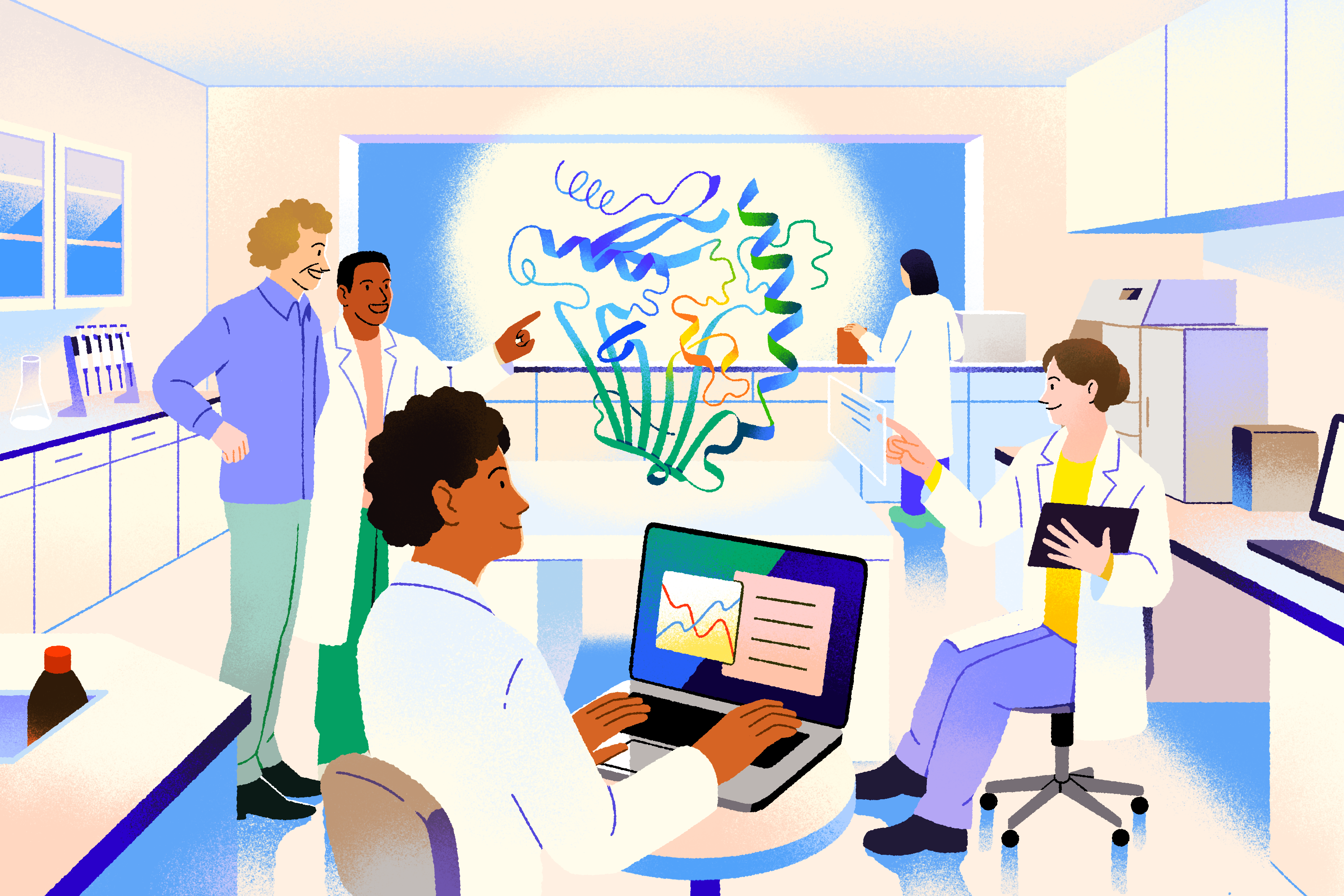
In 2020, Google DeepMind researchers unveiled AlphaFold2, an AI model that tackled a major scientific challenge: Is it possible to determine a protein’s structure from its ingredients alone? The ability to do so without slow and expensive lab experiments carried the potential to revolutionize our understanding of biology and accelerate drug discovery.
At an annual competition of scientists trying to solve this puzzle, AlphaFold2 became the first AI model to perform as well as laboratory experiments. In subsequent years, it predicted structures for more than 200 million different proteins, a 1,500-fold increase over the proteins previously characterized in decades of laboratory work. In 2024, the model’s lead developers received the Nobel Prize in Chemistry.
AlphaFold2 and related models have been “extremely exciting” for science, says Ryan Hill, an assistant professor of strategy at Kellogg. With collaborator Carolyn Stein of UC Berkeley, Hill set out to measure precisely how AlphaFold has changed the field of biology, from the pace and direction of discovery to the nature of scientific work.
Their study provides a preview of what happens when AI transforms a specialized field overnight—a level of disruption that may become increasingly familiar in the future as the world enters the AI era.
“Economists are grappling with a lot of questions around the role of AI in our lives and in the economy,” Hill says. “This is an interesting microcosm to study those forces because it’s a powerful AI tool that does a specific task that we can observe and measure.”
An overnight transformation
While there are over 200 million known proteins, they’re all constructed from the same 20 organic building blocks, called amino acids. Because these components can fold into incredibly complex structures, just figuring out which ones make up a protein is like picturing a car based on a box of loose parts. To then discover that protein’s three-dimensional structure—and better understand how it functions and how it might be controlled—requires even more work. Or at least it used to.
Using experimental methods to determine the three-dimensional structure of proteins takes years to complete and costs an estimated $100,000 per solved protein. As a result, less than 0.1 percent of known proteins had solved structures in 2020.
AlphaFold2 changed that almost overnight, providing millions of structures with similar accuracy as those costly experiments.
“There were many people who had trained for many years with the methods to solve experimental structures,” Hill says. “And then one day, Google DeepMind just ran their algorithm on every known protein and posted it to the internet.”
Enhancement, not replacement
Hill and Stein investigated the impact of AlphaFold’s sudden breakthrough on the world of science by combining multiple scientific databases on protein research. These resources contain information about what scientists have studied and published about every known protein, a data trail that stretches back decades.
“This often happens with technological change. If a task becomes very cheap through automation, that allows people to do a variety of new tasks they couldn’t do before.”
—
Ryan Hill
That allowed the researchers to ask how the seismic shock of AlphaFold2 affected the field of structural biology. At a surface level, the answer appeared to be, surprisingly, not much. In the years since the introduction of AlphaFold2, the number of journal articles using the time-intensive experimental methods to determine protein structure hasn’t declined.
“Structural biologists are still doing what they were doing in many ways,” Hill says. “They’re publishing the same number of papers as they used to, and surprisingly to us, they’re still publishing in the best journals in science—ven though in some ways their work is now substitutable with the AI.”
But looking deeper, the researchers found signs that AlphaFold2 was expanding the abilities of experimentalists instead of replacing them. Structural biologists were using the AI model to augment their skills, leading to faster, more-accurate discoveries.
“There’s often a lot of complementary insight,” Hill says. “The AI is not perfect. There are sometimes variations of the protein or pieces of the structure that are more difficult for the AI tools to predict. The experimental methods can also have quality issues. Combining insights from the experiments and the AI gives us more confidence that we have the correct protein structure in a way that might matter for downstream research.”
A floodlight for science
Additionally, the release of AlphaFold2 appeared to increase the number of proteins scientists researched. Many of the proteins that didn’t have structures before AlphaFold2 emerged weren’t neglected for lack of interest; some may have just been impractical for experimental methods, or there simply might not have been enough structural biologists to keep up with demand.
Hill and Stein found that AlphaFold2 quickly broadened the number of proteins that the field examined, which they describe as a “floodlight” effect.
For example, scientists studying reproduction in zebrafish had identified a key protein, but their laboratory lacked the expertise to determine its structure.
“Those scientists would have had to just wait and hope that someone else would make a breakthrough, and then they can build on it,” Hill says. “And that’s not uncommon in many parts of science.”
After AlphaFold2 came out, the researchers were able to get an AI prediction of the protein’s structure and then use that information to inform further experiments about its function. Their research was eventually published in Cell, one of the leading biology journals.
It’s a pattern Hill and Stein saw across the field.
“Within a few years of AlphaFold’s release, we’re seeing quite large increases in activity on those previously unsolved proteins,” Hill says. “This often happens with technological change. If a task becomes very cheap through automation, that allows people to do a variety of new tasks they couldn’t do before.”
One bottleneck after another
Creating cool three-dimensional pictures of complex protein structures wasn’t the ultimate point of the protein-folding challenge. With those structures, scientists now hope to better understand how important proteins work and eventually influence their activity with new drugs that cure disease, slow aging, or otherwise improve human health.
Hill and Stein looked for evidence that AlphaFold2 was accelerating those downstream discoveries as well. But they didn’t see a significant effect of the AI model’s introduction on drug development—at least not yet.
“Even with a very capable machine-learning tool for those structural steps, it’s only one piece of a very large puzzle,” Hill says. “Because there are so many bottlenecks, there is no single task that you could fully automate that would have any meaningful impact on the rate of drug discovery.”
“The good news is it opens up opportunities, because we can divert our human efforts towards some of those bottlenecks, which will hopefully make us more productive,” he continues. “It will have benefits, but I’m not expecting it to happen overnight.”
A new collaborator
The release of AlphaFold2 came at a vastly different moment for AI—two years before the unveiling of ChatGPT triggered a massive wave of interest in generative AI models and their potential to change how we work. As these models gain new capabilities, anxiety has grown over their ability to replace even highly specialized human workers.
But there are few occupations more specialized than structural biologist. So the story of AlphaFold2 may provide some reassurance to skilled workers in other fields, Hill says.
“There have been a lot of new technologies that have capably done many tasks that human workers did before, so there’s always worry that people will be negatively affected,” he says. “On the other hand, in most past cases of automation, it’s also opened up a lot of new opportunities in the economy, new jobs that appear or changes in the types of jobs that are available. Those types of tools usually make humans more productive.”
A disruptive technology like AlphaFold2 expanding instead of displacing the abilities of human experts provides early evidence for an optimistic vision of human–AI collaboration, in both science and beyond.
“There’s a sense that, if AI can participate more and make scientists extremely productive or even come up with ideas itself, that could have a huge ripple effect around the economy, making more people and more processes efficient,” Hill says. “I find that exciting. That means there could be new breakthroughs that would’ve been impossible without the help of AI tools.”
About the Writer
Rob Mitchum is the editor in chief of Kellogg Insight.
About the Research
Hill, Ryan, and Carolyn Stein. 2026. “How Artificial Intelligence Shapes Science: Evidence from AlphaFold.” Working paper.
Insight in your inbox
Receive our newsletters to keep up with the latest research and ideas from faculty at the Kellogg School of Management.
This website uses cookies and similar technologies to analyze and optimize site usage. By continuing to use our websites, you consent to this. For more information, please read our Privacy Statement.