Featured Faculty
James J. O'Connor Professor of Managerial Economics and Decision Sciences; (Center) Co-Director of the Global Poverty Research Lab (GPRL)
Lisa Röper
When United States President Donald Trump floated the idea of buying Greenland during his first term, the world reacted with disbelief. It seemed utterly absurd, even comical—an imperial fantasy dressed up as a real-estate negotiation. And yet it is true that Greenland matters and that its status could have far-reaching implications.
The renewed attention on the world’s largest island reflects the view that the world is coalescing into three spheres of influence, centered around the United States, Russia, and China. While some dismiss this geopolitical vision as a Trumpian vulgarity, the troubling reality is that it is neither unique to Trump nor entirely irrational.
As the post–Cold War era recedes, a more regional and competitive order is reasserting itself. Large powers shape their immediate surroundings not only out of ambition but also because they face constraints. The farther outward one’s influence extends, the more geography, domestic capacity, or resistance from rivals starts to matter. Russia, China, and the U.S. are each nuclear superpowers and the largest countries in their neighborhood, but each is also limited by many factors outside its government’s control.
Since the Soviet Union’s collapse, the Kremlin has reasserted influence on its neighbors through territorial control, hybrid and frozen conflicts, and economic leverage. For example, Belarus has long been bound to Russia through energy dependence and security integration, so much so that it has effectively lost its sovereignty without being formally annexed. Russia has also backed separatist enclaves in Moldova and Georgia, helped prop up authoritarian governments in Africa, seized Crimea in 2014, and launched a full-scale invasion of Ukraine eight years later. But these efforts have come at an extraordinary cost, and a decisive victory remains elusive. That may offer little comfort to Russia’s smaller neighbors in Eastern Europe, but it suggests that the Kremlin’s sphere of influence has clear and finite limits.
China, which has the world’s second-largest economy, leans more on economic levers than military ones, and its reach appears to be more global than Russia’s. It has leveraged trade and investment ties for geopolitical gain. For example, Cambodia, heavily reliant on Chinese aid and investment, repeatedly blocked the Association of Southeast Asian Nations (ASEAN) from criticizing Chinese maneuvers in the South China Sea in 2012 and 2016. Similarly, after the Chinese state-owned firm COSCO acquired a majority stake in the Port of Piraeus in 2016, Greece vetoed a European Union statement criticizing China at the UN Human Rights Council.
But China’s influence also has limits. Its Belt and Road Initiative to fund infrastructure projects beyond its borders has often caused debt distress and drawn political resistance. Moreover, China faces many challenges at home, including slowing growth, demographic decline, and structural economic and financial weaknesses. Like Russia, its ability to project power beyond its immediate neighborhood is limited.
The Trump administration’s recent assertiveness in the Americas has been widely portrayed as a disruptive break from past U.S. foreign policy. But, in fact, it reflects structural incentives as much as Trump’s temperament.
—
Nancy Qian
The Trump administration’s recent assertiveness in the Americas has been widely portrayed as a disruptive break from past U.S. foreign policy. But, in fact, it reflects structural incentives as much as Trump’s temperament. More-conventional presidents, using gentler language and more-disciplined diplomacy, have pursued similar ends and faced similar constraints.
Consider, for example, that U.S. border patrol had around seven million migrant encounters (when someone is stopped or expelled at the border) during the 2021–24 period and that roughly 86 percent of the heroin and 93 percent of the cocaine consumed in the U.S. enter from Mexico. In an ideal world, the U.S. would pursue domestic measures to reduce American drug consumption and demand and curb migration by making origin countries safer and more prosperous. But that hasn’t happened. Overall, illegal drug use remains pervasive, and even good-faith efforts to drive sustainable economic growth and robust institutional reforms can take generations to bear fruit.
The U.S. (under both Democratic and Republican presidents) has instead tried to curb unwanted flows of people and goods by pressuring its neighbors—especially Mexico. President Barack Obama did so through quiet diplomacy and institutional cooperation, framing enforcement in terms of a partnership, while expanding border control behind the scenes. By contrast, Trump is relying on public confrontation and coercion, using tariffs and other threats to force rapid compliance and deter would-be migrants. Despite these differences in style, the underlying objective of shaping neighbors’ policies to serve U.S. interests remains a constant.
That brings us back to Greenland. While the outrage at Trump’s threats is understandable, the shock is somewhat naive. This is hardly the first time that the U.S. has openly shown an interest in Greenland or demonstrated that it wants more freedom to act unilaterally in the Arctic. It explored options to purchase the territory in the 19th century, occupied it during World War II, offered to buy it outright in 1946, and refused to abandon its military presence thereafter.
The U.S. has also pushed against the constraints imposed by the 1951 U.S.–Danish Defense of Greenland Agreement, such as through unilateral initiatives like Project Iceworm, a plan to deploy nuclear missiles beneath the ice sheet. Similarly, the U.S. has treated the Northwest Passage as an international strait and provoked diplomatic crises with Canada, which claims the passage as part of its internal waters.
U.S. tensions with its Arctic allies eased after the Cold War. But as melting ice opens Arctic sea routes and intensifies a renewed geopolitical power competition in the region, Greenland’s strategic value has increased, making the reemergence of frictions unsurprising. Russia is already entrenched in the Arctic, and China is laying the groundwork through dual-use scientific research, icebreakers, Arctic-capable technologies, and cooperation with Russia.
Trump’s theatrics are confrontational, but the impulse behind them is familiar: ensure a U.S. presence and unilateral decision-making capabilities, deny rivals access, and control strategic points on the map. Another president might rely on quieter diplomacy and better alliance management, but the objective of maximizing operational autonomy to protect American strategic interests would likely be the same.
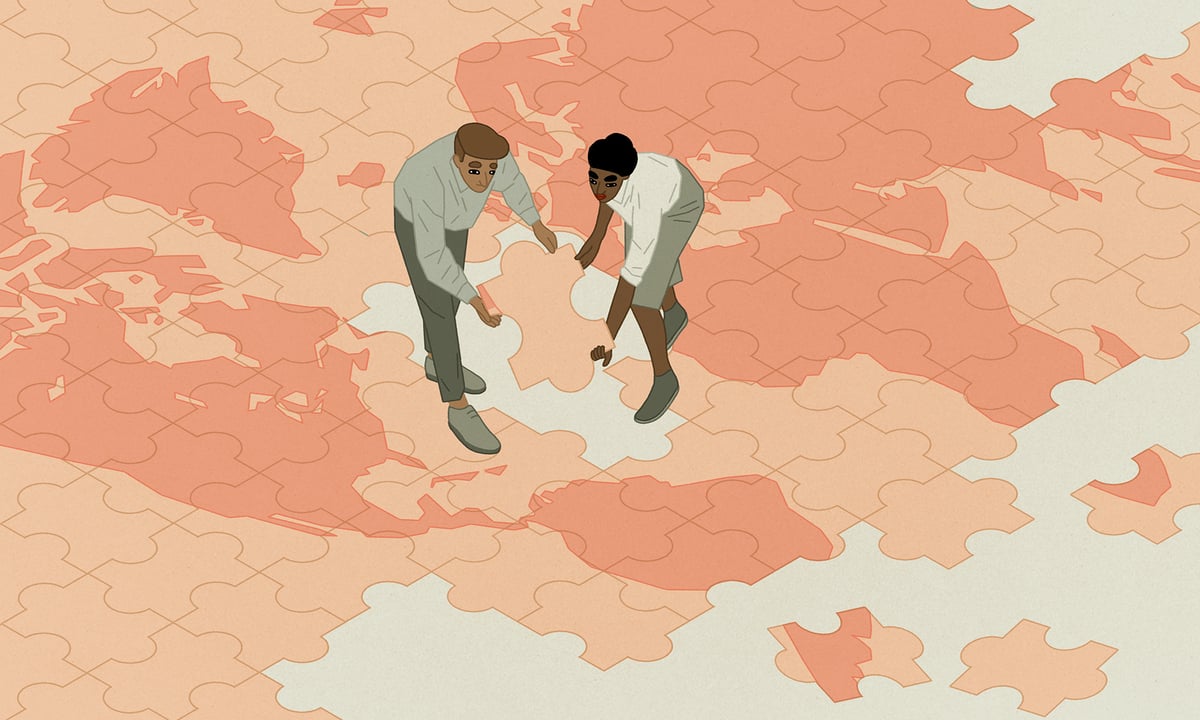
Geography, security, and economics may be reshaping the world into three rival spheres of influence. But recent events show that power has limits. Russia’s expansion has been ruinously expensive. China is constrained by mounting domestic strains. And a U.S. pivot to the Americas—for all the bluster—may betray recognition that primacy is unsustainable without allies.
The fixation on Trump misses the bigger picture. Structural forces, more than personalities, drive geopolitical change. Recognizing this is essential to finding space for compromise and renewing the alliances needed to preserve political and economic stability.
*
This article originally appeared in Project Syndicate.