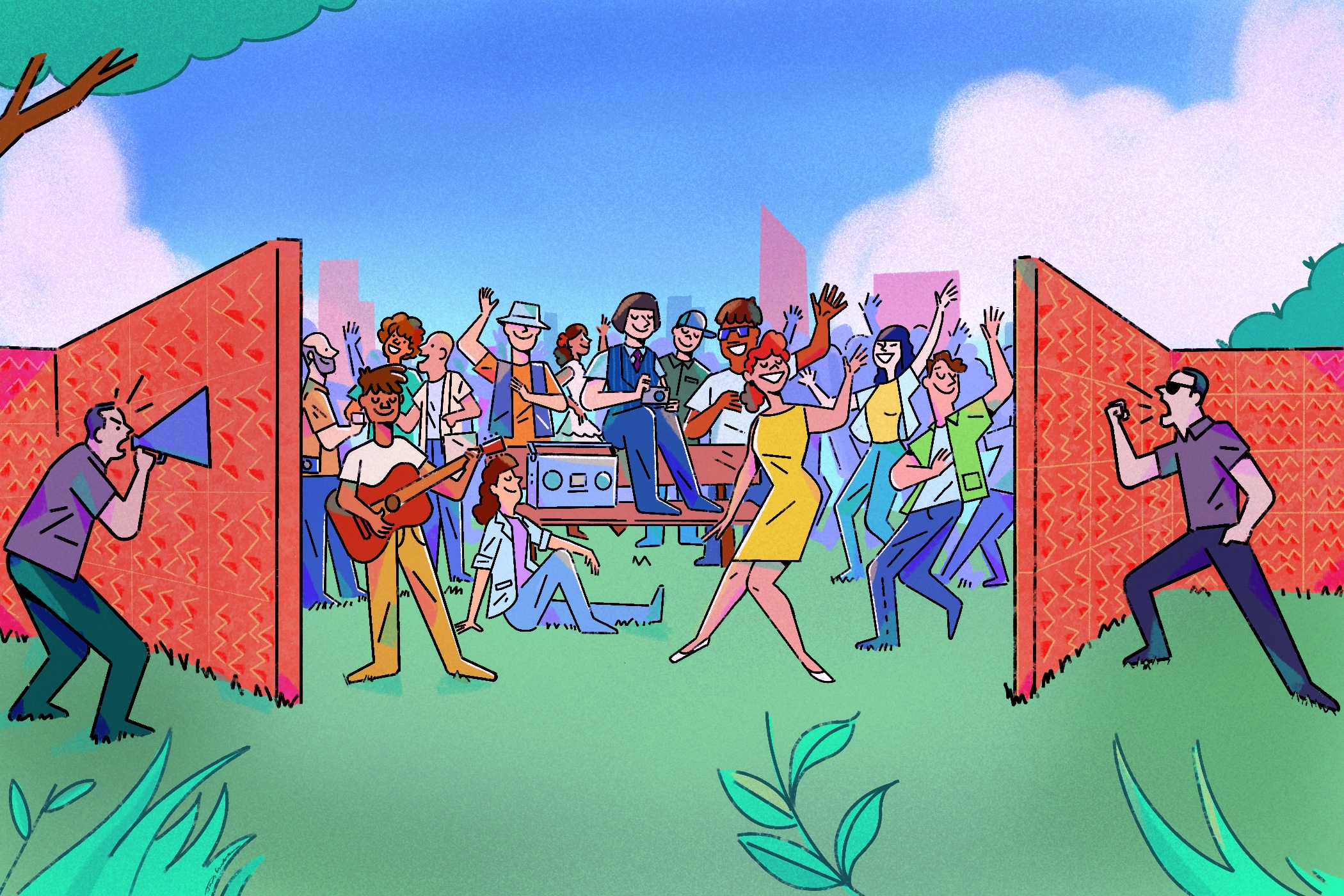
Whether the topic is politics, sports, movies, or music, it often feels like the loudest and angriest voices dominate the conversation, creating a virtual shouting match that drowns out more-thoughtful opinions.
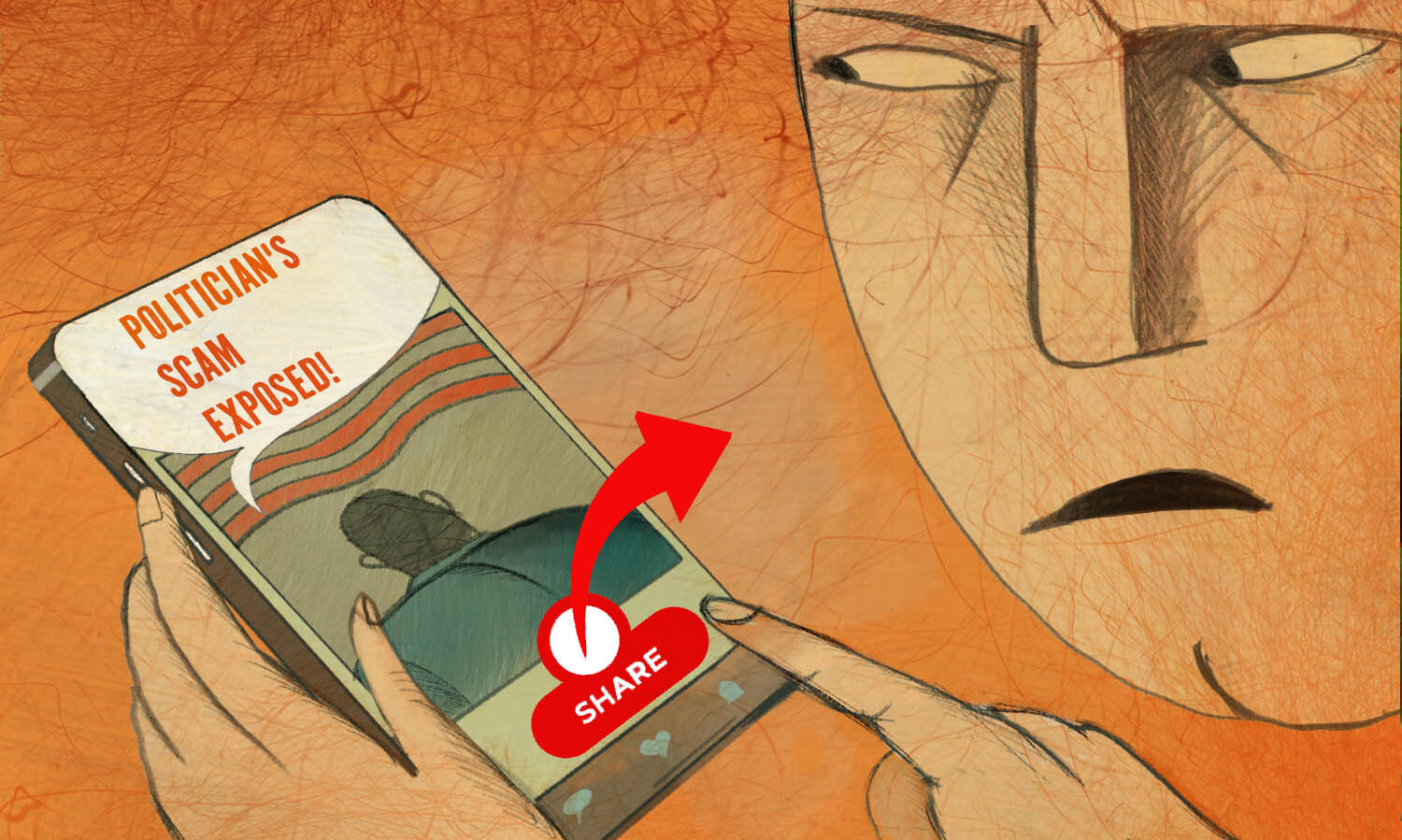
Scientists have speculated that these flames are fanned by the engagement-based algorithms social-media networks use to keep users on their platform. These algorithms exploit a known bias: that people tend to pay the most attention to information that is moral, emotional, and relevant to their social group, says Kellogg’s William Brady, an associate professor of management and organizations.
“Algorithms learn that factor of our psychology, they amplify it, and then it leads to a situation in which our ecosystem is saturated with this information,” he says.
Breathing in that atmosphere every day may start influencing how people see the world—as more polarized, more angry, more toxic.
Brady and a team of colleagues at Kellogg wondered if there was a better way to experience social media. So they compared a new algorithm that reduces the influence of the loudest users with an engagement-based algorithm similar to the kind used on major social-media platforms. Then they studied how people responded to the respective feeds during one of the most fractious moments in recent history: the 2024 U.S. presidential election.
Their results, published in Nature, offer a glimpse at a calmer and more enjoyable social-media experience, one that could benefit both users and the social-media companies that hope to retain them.
“We’re starting to see evidence that people are using social-media less than they had the previous year, for the first time since the advent of social media,” says Brady. “The hyperfocus on short-term user engagement has been very profitable, but I think we’re starting to hit a point in which that’s going to give diminishing returns.”
A real-world test
For the study, Brady collaborated with fellow Kellogg professors Eli Finkel, Nour Kteily, and Jacob Teeny; Kellogg students Meriel Doyle, Abdo Elnakouri, Victoria Parker, Curtis Puryear, Trevor Spelman, and Mark Torres; and former Kellogg postdoctoral researcher Joshua Conrad Jackson.
The researchers analyzed over 20 million posts on the social-media platform Bluesky to get an unfiltered baseline of the site’s conversation.
Nearly a quarter of Bluesky posts included political language, while 6 percent of posts were classified as toxic. Posts containing in-group, moral, or emotional content—the target of the psychological bias the researchers were most interested in—comprised almost 16 percent of the total.
Then the team created an engagement-driven algorithm based on the strategies used by sites like X, Facebook, and TikTok. The feeds driven by this kind of algorithm tend to amplify a small number of accounts that excel at creating controversial content that provokes a response, whether it’s positive or negative.
“It promotes these extreme users to a point where they look like they represent more of the information ecosystem than they really do,” Brady says. “We know that they express more toxicity than the average person—a lot more.”
The team also built a second algorithm that better reflects the overall conversation on a given social-media platform. Importantly, the algorithm did not moderate for controversial content or select a diverse range of political views. Instead, it merely turned down the volume on the accounts that engagement-driven algorithms typically overamplify.
“We’re trying to reduce the influence of these politically extreme users,” Brady says. “But we’re not making any kind of top-down decision about content itself. It just has to do with evening the playing field for user voices in your social network. It’s about representativeness.”
The researchers tested these two algorithms—and a simple reverse-chronological control feed—on a pool of 2,000 users of Bluesky, which allows custom feeds. The participants randomly received one of the three feeds for eight weeks before and after the 2024 U.S. election.
More engagement, more toxicity
As predicted, the engagement-based feed increased the visibility of the in-group, moral, and emotional content types, particularly after the election. Users on the engagement-based feeds also saw 57.3 percent more political posts compared with users on reverse-chronological feeds after the election.
“We have causal evidence that these algorithms are amplifying this content,” Brady says. “We’re showing that, compared to the actual base rate, people are in a situation where they’re not getting a true readout of what the underlying conversation in the network looks like.”
By contrast, the researchers’ new algorithm decreased the amount of in-group, moral, and emotional content, as well as the amount of toxic and political posts users saw, relative to engagement-based feeds, both before and after the election—even though the algorithm wasn’t specifically told to moderate the content.
“We’re not making any claims about what is good or bad,” Brady explains. “We’re just reducing the influence of extreme users to make feeds more representative, and what we find is ... you reduce some of the most divisive content.”
A polarized lens
In previous work, Brady theorized that heightened exposure to charged online content can lead to misperceptions about society, for instance, making people feel that others are more polarized politically or more accepting of extreme views. So, the researchers next tested how the three different feeds influenced users’ perception of social norms online.
People who received the engagement-based feed were less accurate at perceiving social norms and overestimated partisan animosity.
“If you’re in the engagement-based algorithm, you think that your network really doesn’t like the other political side,” Brady says.
But curiously, users with engagement-based feeds underestimated the acceptability of toxic language. In other words, despite seeing more toxic posts, these users thought their network was less tolerant of toxic posts than it actually was. Brady thinks this may be because toxic language is often accompanied by community pushback: “You see a bunch of fighting, and so you think, ‘I guess maybe my network doesn’t find this appropriate. That’s why there’s so much conflict surrounding the people expressing toxicity.’”
In addition, these users didn’t interact more with in-group, moral, andemotional content or with toxic content. In fact, hardly anyone in the study engaged with these types of content at all. The finding reinforces the idea that the majority of social-media activity takes place on the fringes of the network, with small groups dominating both the posting of and engagement with extreme content. But because of algorithms that amplify community-based signals of engagement, this content spreads like wildfire.
“There’s this massive asymmetry,” Brady says. “I think that’s a big insight for social-media companies.”
Enjoyable without the engagement
Still, social-media platforms argue that they need engagement-based algorithms to keep their users happy and active.
But the researchers found that people were in some ways happier with the new, less-polarizing algorithm.
“Not only did [the new algorithm] not lose people because they were bored, they actually said they enjoyed the platform more when they used our algorithm relative to the engagement-based condition,” Brady says. “So this idea that there’s a trade-off in getting rid of certain types of divisive content that draws engagement may be overstated.”
The finding confirmed the researchers’ theory that people might even prefer a more-accurate representation of the overall conversation on a social-media platform. Such an approach could also restore one of the early, optimistic promises of social media: the opportunity to elevate many voices that often go unheard.
“We think it’s very important to raise voices that are being shadowed by the algorithms and then limit voices that are dominating just for public discourse,” Brady says. “A lot of people aren’t expressing their opinions, and that’s partially because it looks horrible out there …; you feel concerned that you’re going to get attacked because there’s a lot of toxicity. But this is not inevitable.”