One of the most important aspects of the retail process marketers face is deciding how to optimally price their products or services. Charge too much, and you might stifle interest. Charge too little, and you are leaving money on the table.
Kellogg professors Derek Rucker and Eric Anderson and a colleague surveyed the existing research to determine whether there is a consensus on the best way to determine customers’ willingness to pay (WTP). They found that existing methods were insufficient and left out key contextual information that might improve efforts to accurately measure this factor.
“You might pay upwards of $10 for your favorite beer at a fancy hotel bar, but only $5 for the same beer from a beachside vendor,” says Anderson. “That difference in WTP may be completely rational and driven by what alternatives are available. Just asking consumers what they are willing to pay misses a critical aspect of the metric, which is the comparisons consumers are considering.”
The team introduced a new approach, called the Comparative Method of Valuation, that is customizable to different situations and allows marketers to see which alternatives consumers are considering. The method keeps comparisons with competitors in mind at all times.
“As a marketer, you need to not only understand what your brand offers—you also need to understand who you’re competing against,” Anderson says. “We can’t become so brand-centric that we just focus on ourselves. We have to know what alternatives consumers are bringing to mind.”
Changing prices can also be slow for practical reasons; it takes time and labor to replace the price tags on products in stores. But new digital technologies have made rapid price fluctuations more common, including the infamous practice of “surge pricing” during times of high demand.
For many customers, the adoption of surge pricing by companies like Uber raised red flags over its potential for misuse. When grocery giants Walmart and Kroger announced that they would install electronic shelf labels, similar alarms went off.
“Some people might say that the fact that these stores are willing to pour so much money into installing these electronic shelf labels is prima facie evidence that they plan to surge prices, because there’s no reason to install them otherwise,” says Robert Bray, an associate professor of operations at the Kellogg School.
But when Bray and his colleagues crunched transaction data from more than 100 grocers, they found that surge pricing in the grocery aisles is highly unlikely for several reasons. Stores carry too many products, have too many separate contracts with suppliers, and see too little chance to profit on individual products without putting off faithful customers whose return purchases make up the industry’s profit focus.
Instead, U.S. grocery retailers claim digital price labels will make stores more efficient and lower the costs of pricing. So far, it appears that these retailers have refrained from juicing profits through quick price hikes. If anything, digital price labels are more likely to be used to run markdowns that would help sell perishable products before their expiration dates pass.
“Now we see that keeping prices relatively stable was not a technological limitation; it was a sound business decision,” Bray says.
One of the most fundamental relationships in marketing is between how much customers want something and the price they are willing to pay. But determining a product or service’s demand curve can be fraught according to Suraj Malladi, an assistant professor of managerial economics and decision sciences at Kellogg.
Change prices too slowly—or too quickly—and you risk reducing margins or losing customers. To avoid this, many firms resort to the simple method of gradual, incremental price increases, testing for where demand starts to fall off.
“In other words, firms act as if their demand curve is ‘kinked’: dropping prices would barely stimulate demand, but raising prices would rapidly drop demand,” Malladi says.
Malladi has developed an economic model to show the reasoning behind this approach as well as how it can drive up prices in the long run. The model simplifies the price-setting process in several ways. First, it makes the demand curves persistent—meaning demand is stable over time. Next, firms in the model do not know the demand for their product or service at the outset.
It also assumes that the firm’s pricing experiments happen sequentially and relatively infrequently—“a high-stakes, low-velocity decision,” as Malladi describes it. This increases the consequences of bad pricing.
“Many businesses set uniform prices and change them infrequently,” he says. “For those businesses, it is important to think carefully about the order in which you change prices.”
While the model only accounts for some types of pricing factors—it leaves out processes such as dynamic pricing and promotional sales, and price shifts for changing demand—it does shed light on the way companies gather information about demand for products and services through gradual price hikes.
“Venture capitalists and management-consulting firms give advice on how firms should be changing their prices around, and the message is often ‘raise prices.’ The model gives one economic justification for why they might suggest that,” Malladi says.
Among the contextual factors that affect pricing is the targeted audience for a particular product or service. For example, products marketed to women have traditionally been priced higher than those marketed to men. But are women paying more for the same thing—a “pink tax” that amounts to price discrimination?
This was a question Kellogg’s Anna Tuchman and colleagues examined in a study that focused on factors that might account for the price difference. What they found was that the components of the products themselves were different—using different ingredients, for example—and those differences accounted for the price gaps.
Their study focused on personal-care products marketed to both men and women which were sold in Walgreens stores across the United States. While they confirmed that products marketed toward women were more expensive, their ingredient makeup was substantially different. When accounting for those differences, an apples-to-apples comparison among products found that the price differences “wash out across categories,” according to Tuchman.
This doesn’t necessarily mean women pay the same amount for personal-care products as men, however. Cultural expectations mean the volume and range of products marketed to women is much larger.
“The basket of goods is just larger for women,” Tuchman says. “Within the basket, individual items may have the same price, but it’s a bigger basket.”
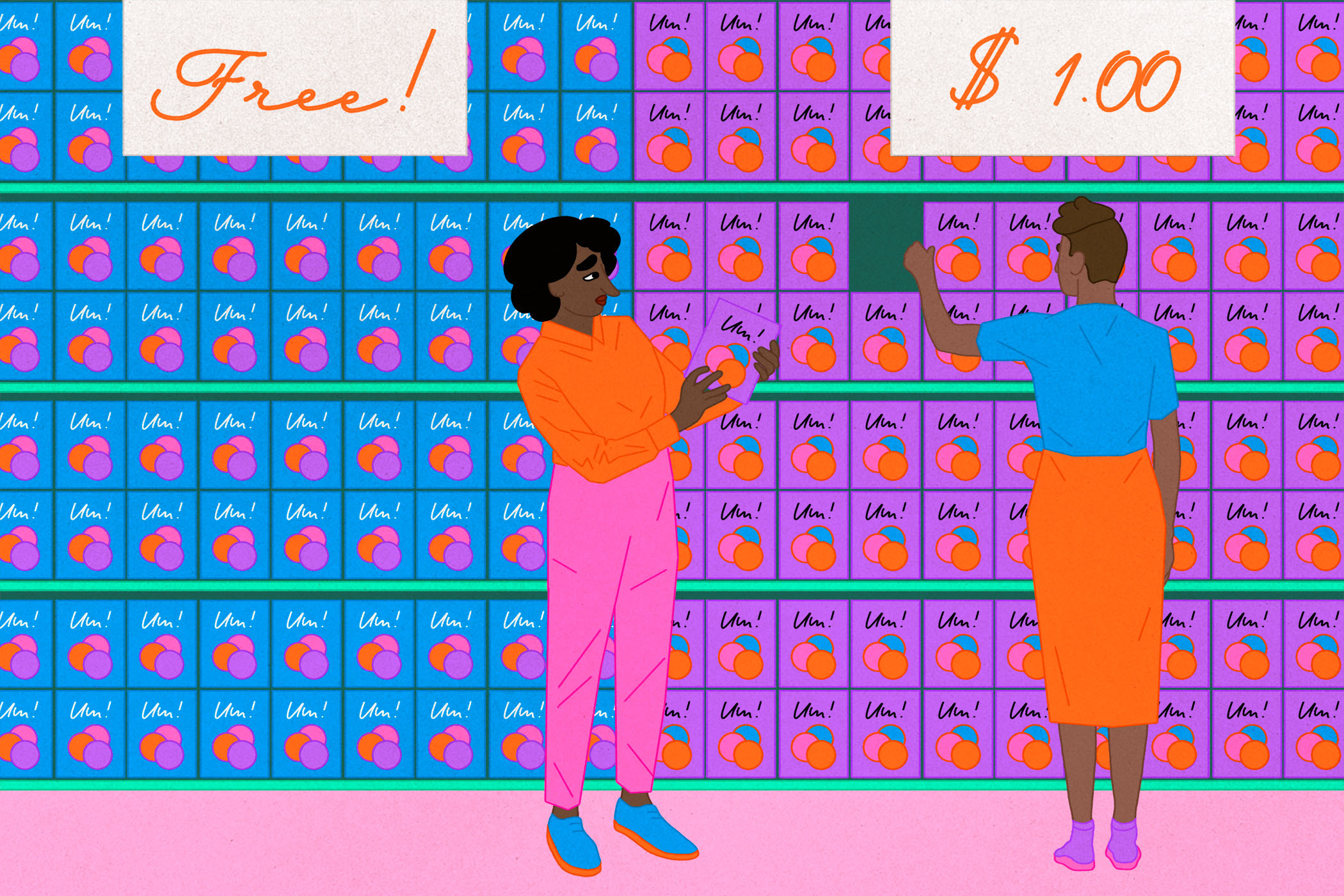
One strategy available to companies looking to build buzz for a new product is to offer it for free so customers have an opportunity to try it out before opening their wallets.
But is a “zero-price” strategy the best way to build an audience?
Kellogg’s Galen Bodenhausen and two colleagues conducted research to test whether free is always the most attractive price, or if there are circumstances when charging a nominal fee might be preferable to customers.
“We wanted to find out, what are the limits of the zero-price offer?” Bodenhausen says. “We wanted to show that even though it seems intuitive to offer a product for free, it’s not always in the marketers’ interest to offer a zero price. There are certain circumstances where a low, nonzero price can do a better job of increasing demand.”
The researchers found that when there are high incidental costs to the purchase—such as the time and effort to buy it—the calculus for buying changes. When the product is free, consumers pay more attention to those nonmonetary costs.
In cases such as these, the researchers tested whether offering a low, nonzero price can be more attractive to consumers. They found that when consumers had to weigh the purchase and the effort to make the purchase, paying a small fee was more attractive than receiving a free product.
So zero prices should be avoided when the incidental costs are high—for example, when people have to commute to a location to pick up their free product.
The researchers were surprised by this result, Bodenhausen adds. “I thought maybe people would be suspicious of a 1-cent price, that perhaps it might trigger greater scrutiny, but it was still much more effective than a zero price.”