Researchers at the Kellogg School keep an eye on political campaigns as well, studying everything from the ways candidates are packaged, the effectiveness of their messaging, and the information environments in which they operate.
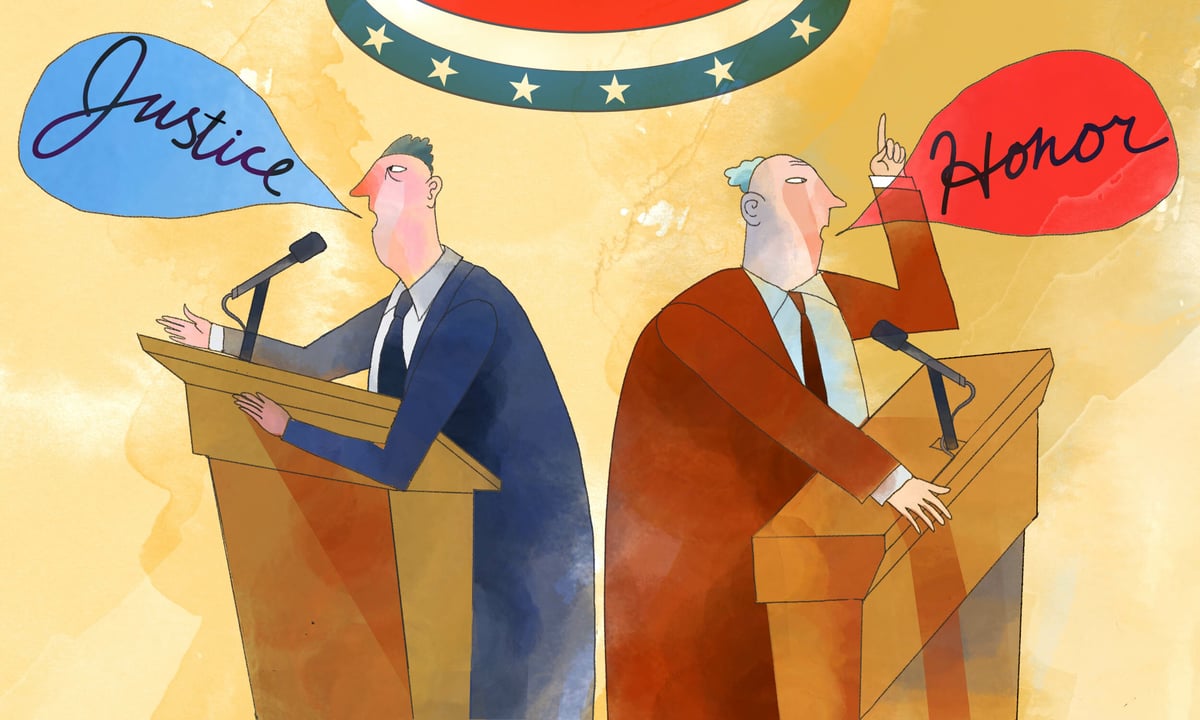
What makes a candidate stand out on the campaign trail? While their policies may differ, politicians who adopt the tropes of standard stump speeches can be hard to tease apart. But Kellogg professor William Brady finds that, beyond the party lines, the moral language candidates employ can tell a lot about where they stand.
In a study, Brady and his colleagues looked at tweets made by U.S. politicians during the 2016 and 2020 election cycles. They found that Democratic and Republican politicians leaned on moral language in very different ways, a finding that may shed light on the nation’s highly polarized politics.
“Democratic politicians tend to really emphasize care and fair treatment, whereas Republicans tend to focus a lot more on things like in-group loyalty and respect for social hierarchy,” Brady says. Voters “are being fed this rhetoric that is appealing to very different values.”
Regarding whether politicians appealing to the values of voters is exacerbating polarization or is a product of that polarization, Brady thinks it is likely a bit of both, and mostly because those appeals connect with voters.
“There’s some work suggesting that when you make appeals in the moral-value frames that partisans are comfortable with, it’s more likely to be persuasive.”
Every election season, voters are inundated with mailers and flyers touting candidates and ballot initiatives that politicians and interest groups hope will sway voters’ choices. Direct mail is a huge industry—but is it always effective?
A study by Kellogg’s Georgy Egorov and colleagues looked at the limits of political direct-mail campaigns and found that, in some cases, they can backfire, reducing support for a candidate or cause.
The researchers measured the direct and indirect effects of a leaflet campaign from the 2023 Argentine presidential election. The leaflets, mailed to residents in Salta Province, enumerated the potential adverse consequences of right-wing candidate Javier Milei’s proposals.
They found that people who received the leaflets were less likely to vote for Milei. But the campaign also had an indirect effect—among those in the same neighborhoods who did not receive a leaflet, support for Milei increased so much that it overshadowed the direct effect on recipients.
“That the indirect effect was bigger than the direct effect—and also in the opposite direction—is not something that we anticipated,” Egorov says. “It really challenges what we know about the spread of ideology over social networks.”
This finding is important for people who lead campaign and outreach efforts, who should reconsider how their messaging might affect people beyond their target audience. For managers and marketers, the lesson is similar: it’s not enough to understand how the target audience reacts; you also need to anticipate who is more likely to talk about your message, and how.
Strong-armed leaders have been increasingly popular in many areas of culture—from politics to sports to business. Kellogg professor Maryam Kouchaki and colleagues studied the appeal of this leadership style with U.S. and European people across racial and ethnographic as well as political lines. What they found was eye-opening.
Through a series of studies based on data from 2016 through 2023, they found that ethnic minorities favor strong political leaders significantly more than do white individuals. This preference applies even across political lines: ethnic minorities who are Republican tend to have the greatest preference for strong political leaders, followed by ethnic-minority Democrats and white Republicans, with white Democrats the most averse.
So how do the researchers’ findings square with polls that routinely show that ethnic minorities tend to align themselves with the political left? The answer seems to be connected to people’s level of trust.
In the same surveys they conducted about strong leaders, the researchers also asked participants questions to measure their trust in other people. They found that, on average, ethnic minorities had much less trust in others than white respondents and that this lower level of trust correlated with their preference for strong leaders.
“Our research indicates that these preferences extend beyond politics and are also evident within organizations,” Kouchaki says. “Recognizing and understanding these differences is essential for effective leadership.”
In an era of constant campaigning, elected officials have to be keenly aware of how anything they say may be interpreted. Say something that conflicts with your own party’s orthodoxy, and you risk alienating your own voters.
Given the highly polarized political environment in the U.S., you might think that bucking the party line would lead to a backlash. But research from Kellogg’s Eli Finkel, Nour Kteily, and colleagues found that, regardless of party, politicians consistently and substantially overestimate that fear.
“Healthy democratic discourse depends on people being willing to voice dissenting views within their own coalitions,” Finkel says. “But when people systematically overestimate the social costs of doing so, we end up with a distorted picture of what people actually believe—and that undermines the quality of political deliberation within parties.”
The researchers were surprised at how strongly the evidence showed a disconnect between anticipated and actual social reactions to dissent. They found that this overestimation appears linked to self-censorship behavior. In their studies, those who anticipated stronger backlash were more likely to report staying silent about dissenting views. This may contribute to a false impression that political parties are more uniform and divided than polling data suggests they actually are.
So when people voice dissent—even in the face of social cost—it makes the actual diversity of opinion within groups more visible. This visibility can help correct the false impression of uniformity that keeps others silent.
In addition to the risk of saying something controversial, political leaders face other circumstances that may lead to backlash against them. Research from Kellogg’s Neal Roese and colleagues found that constituents blame politicians for near-disastrous events on their watch, even if the disaster didn’t actually strike. Think events like a third of the U.S. population dying because of the Covid-19 pandemic, or a nuclear attack by North Korea against the U.S.
These “counterfactual catastrophes,” as psychologists refer to them, are conveniently more likely to be blamed on politicians of opposing parties, the researchers found. In addition, people believed that a counterfactual catastrophe was closer to actually happening when it was under the watch of a leader they opposed.
“Our research shows that thinking about bad things that did not happen, yet nevertheless could have happened, is a powerful input into moral reasoning,” Roese says. “The surprise for me was how much people can vary in the way they think about alternative societal outcomes that are worse than what has actually happened.”
It’s not rare for people to distort facts when talking politics, explains Roese. “Sometimes it reflects misunderstanding, sometimes deliberate deception. But this research goes further in showing how political loyalties can shape imagined alternatives and the moral conclusions that emerge from those imaginings.”